 mrsentry
How it works
mrsentry runs as a job in your GitLab pipelines. Merge request pipelines review the change and fix it. Scheduled pipelines just fix.
Review, scan and fix inside the MR
Inline comments and one overview note. If the image has fixable CVEs, a follow-up job pushes the fix into the same MR.
mrsentry run mrOpen one fix MR from the latest scan
No code review. Scans the newest image, fixes what it can and keeps a single, up-to-date fix MR open.
mrsentry run scheduledMerge request pipeline
Runs on every push to a merge request. It takes about one to two minutes for a typical change.
-
01Load the merge requestGitLab API
Reads the MR and its latest diff version, so every comment lands on the right line.
Details
- The diff version supplies the base, start and head commits GitLab uses to position comments.
- Every page of diffs is read. Files GitLab truncates as too large are diffed locally instead.
- If a push has just landed, it waits for GitLab to finish computing the new diff.
-
02Check out the exact commit
Works from the full repository at the MR head, not just the diff.
Details
- In CI it reuses the job's checkout (
$CI_PROJECT_DIR). Elsewhere it clones. - The token goes in an HTTP header, never in the URL or logs.
- It confirms
HEADis the commit being reviewed.
- In CI it reuses the job's checkout (
-
03Scan the container imageoptional
Pulls High/Critical CVEs from ECR and traces each one to the dependency that brings it in.
Details
It reads how the repository is scanned (basic or enhanced, on push or continuous) and checks whether the results are fresh enough to trust. ECR scanning has the details.
-
04Review the changeAI
Reviews risky files first, checks claims with repository tools, and drops anything it can't back with evidence.
Details
- Auth, crypto, SQL, payment and I/O code goes first, then the largest changes.
- The model can read files, grep and look up symbols, all read-only.
- Each finding must quote the real line. A critic pass removes noise and duplicates.
AI code review covers every step.
-
05Publish to the MR
Inline threads plus one overview note, posted in a single batch so watchers get one notification.
Details
- A comment GitLab can't place inline falls back to a file comment, then to the overview.
- Threads whose issue is gone are resolved. The overview is edited in place, never reposted.
- If someone pushed during the run, it stops (exit code 2) instead of commenting on old lines.
-
06Hand off the fix
If something is fixable, it starts a child pipeline that pushes the fix into this MR.
Details
It writes
mrsentry-out/fix-pipeline.yml. That file holds either amrsentry:fixjob or a no-op job that states why nothing is needed.
Why a child pipeline?
GitLab decides which jobs exist when a pipeline starts, so an earlier job can't switch a later one on. mrsentry writes the fix job into a generated child pipeline only when there is something to fix. The child reuses the parent's scan report, so it needs no AWS credentials.
fix-pipeline.ymlContains the fix job, or a no-op that explains why not.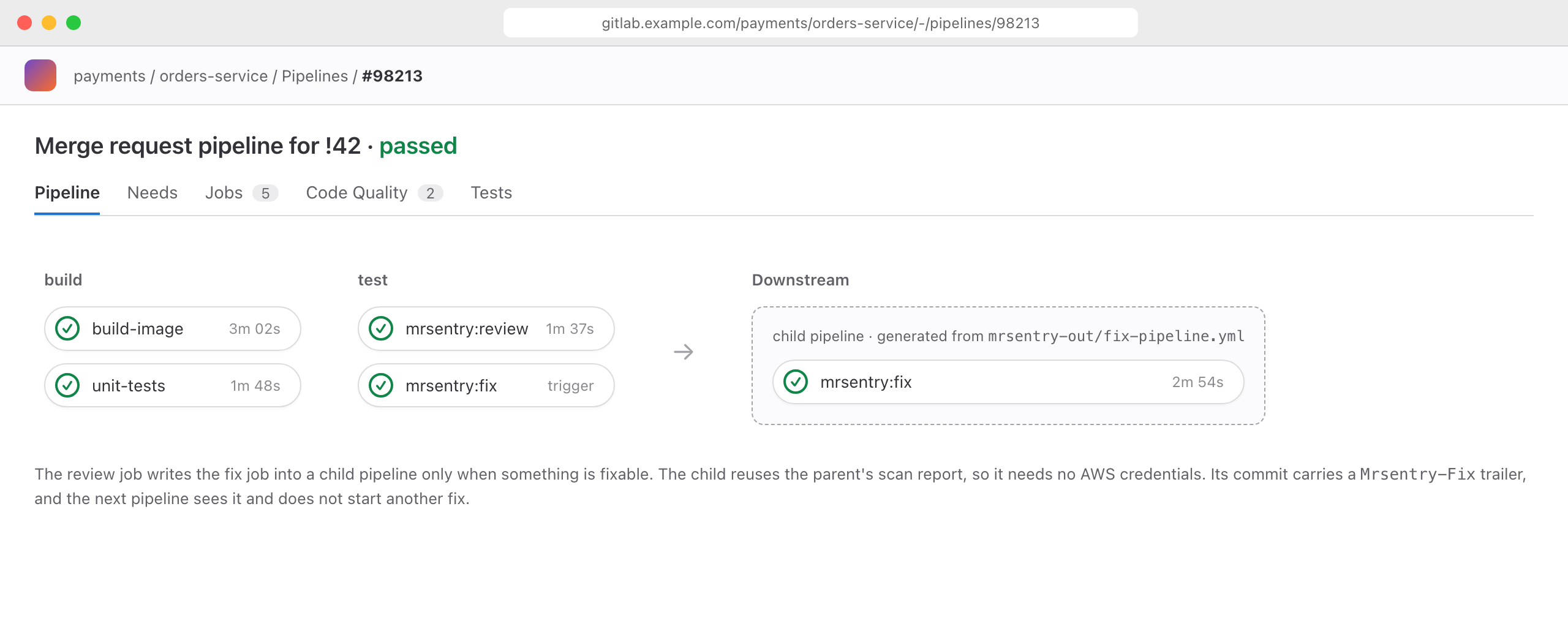
Scheduled pipeline
Runs nightly, or whenever you schedule it. No review, just one fix MR that stays up to date.
-
01Clone the target branch
Starts from your default branch, or the one you choose.
Details
Set it with
fix.target_branchor--target-branch. -
02Scan the latest image
Without a tag, it picks the newest image for you.
Details
ecr.tag_strategypicks the most recently pushed image (default) or the highest semver tag.ecr.tag_filterlimits the candidates. -
03Fix and verify
Upgrades the dependencies, regenerates lockfiles and proves the vulnerable versions are gone.
Details
This is the same engine as the MR fix, including your build and tests. See Vulnerability fixing.
-
04Open or refresh one MR
One MR per set of CVEs. Re-runs update it, and a newer set closes the older MR.
Details
The branch is
mrsentry/vuln-fix/<image>-<fingerprint>, so the same set of CVEs always maps to the same branch and MR.
Built in
Loop guard
Every fix commit carries a Mrsentry-Fix trailer. When the pipeline runs on the bot's own commit, mrsentry sees the trailer and skips the fix, so it never triggers itself.
Artifacts for every run
Written to mrsentry-out/ for GitLab and for later jobs:
mrsentry-report.jsoneverything, machine-readablegl-code-quality-report.jsonMR widgetmrsentry.envdotenv for later jobsmrsentry-overview.mdthe overview note